India’s alcobev industry is undergoing a quiet but powerful shift—and at the heart of it are voices like Charnelle Martins.
Once defined by legacy systems and male-dominated spaces, distilleries today are evolving into hubs of innovation, diversity, and technical excellence. Martins stands as a strong example of this transition—bringing together science, skill, and a sharp point of view that challenges the status quo.
From redefining the image of a “master distiller” to pushing Indian spirits onto the global stage, her work reflects where the industry is headed—and who is shaping it.
In this exclusive conversation, she opens up about navigating a technical field, breaking outdated perceptions, and why India’s spirits story is just getting started.
Distilleries in India have long been male-dominated. How has your experience been working in this space?
Distilleries in India were for the longest time have been a male dominated space but it looks a lot different today. From the brew-house to the boardroom, women are now leading the charge as brewers, distillers, and owners.
In a field this technical, your expertise is the ultimate equalizer. There’s simply no substitute for hard work and dedication to the craft though a generous sprinkle of self-confidence certainly helps. Don’t let dusty industry ‘norms’ hold you back!
What are you actively trying to change in the industry today?
I’m on a mission to give the ‘Master Distiller’ archetype a much-needed makeover. For way too long, the image of a distiller has been stuck in the past, usually involving an old-school ‘gentleman’s club’ vibe. I’m here to prove that technical expertise doesn’t care about your gender or age; it only cares about what’s in the glass
While we’re at it, can we finally retire the idea of ‘gendered’ drinks? The notion that certain spirits are for men and others are for women is just bad marketing; considering we are half the consumers! Women aren’t just sipping drinks; we’re the architects behind the most sophisticated libations on the shelf!
Ultimately, I’m working to make female leadership the ‘norm’, be it in production, R&D, or operations. I want to move us from being the ‘headline-worthy exception’ to the industry standard. I’m working towards being more intentional about mentoring and encouraging others, especially those starting out or unsure if they belong here. The ripple effect is real, and I’m excited to keep spreading it.
Where do you see India heading in the next 10 years in your field?
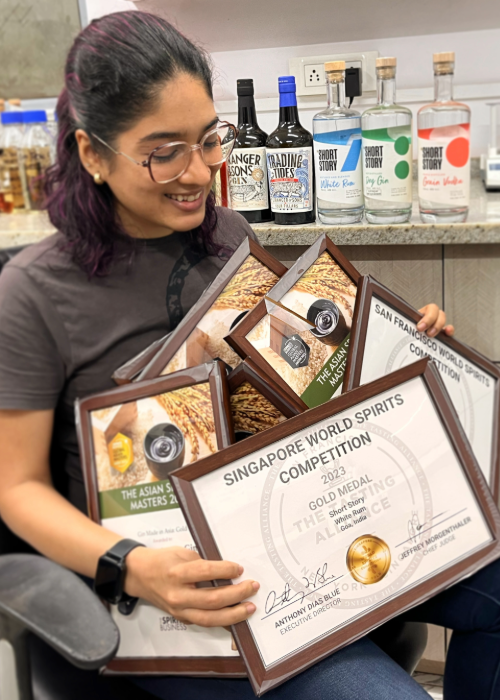
In ten years, Indian single malts, craft rums, gins and agave spirits won’t just be the ‘local alternatives’ to imported brands; they’ll be the global benchmarks. We’re moving away from the era where a dusty bottle from abroad was the ultimate status symbol and heading toward a decade where Indian provenance is a luxury cue in its own right.
It’s about time we stopped being modest. With our unique climate, ‘tropical aging’ isn’t just a buzzword; it’s our advantage, giving us a head start that colder climates can only dream of. When you pair that environment with our incredible access to botanicals and most importantly a massive pool of brilliant local talent, you get a powerhouse. We’re moving from being a market that consumes to a nation that defines what the world is drinking.
Are there everyday disadvantages women face that are often normalised for men?
The idea that women face some unique disadvantage on the distillery floor is a myth we’ve already debunked. The copper pot doesn’t care who’s checking the brix or monitoring the flow, and neither do we. We’re doing the same work, with the same rigor, often with even better results. But if we’re talking about a unique edge, the female perspective is a massive technical asset. Statistically, women often possess a more nuanced sense of smell and a more sensitive palate. In our world, that’s essentially a superpower.
The Bigger Shift
Charnelle Martins’ journey reflects a larger transformation underway in India’s alcobev industry.
The conversation is no longer about inclusion for the sake of optics—it’s about capability, innovation, and leadership. As more women step into roles across distilling, brewing, and operations, the industry is not just becoming more diverse—it’s becoming stronger and more dynamic.
And if Martins’ vision holds true, the next decade won’t just see India participate in the global spirits conversation—it will lead it.